Luxury Train TravelRomance, Reality, and What to Know Before You Book
At a Glance
- The core promise: Luxury train travel turns the journey into the destination — the train is the hotel, the restaurant, and the transport, moving together
- The romance: A moving viewpoint through scenery you can't reach by road, with the logistics of a multi-city itinerary absorbed into a single cabin
- The reality: A fixed route, a fixed schedule, a cabin smaller than a hotel room, and a price that reflects onboard service rather than miles
- What to know before booking: Direction of travel decides the scenery; dietary needs must be flagged in advance; pack for a moving boutique hotel, not a resort
- The advisor's role: The difference between a good cabin and a great one isn't visible on a booking platform — and that's exactly what a travel advisor knows
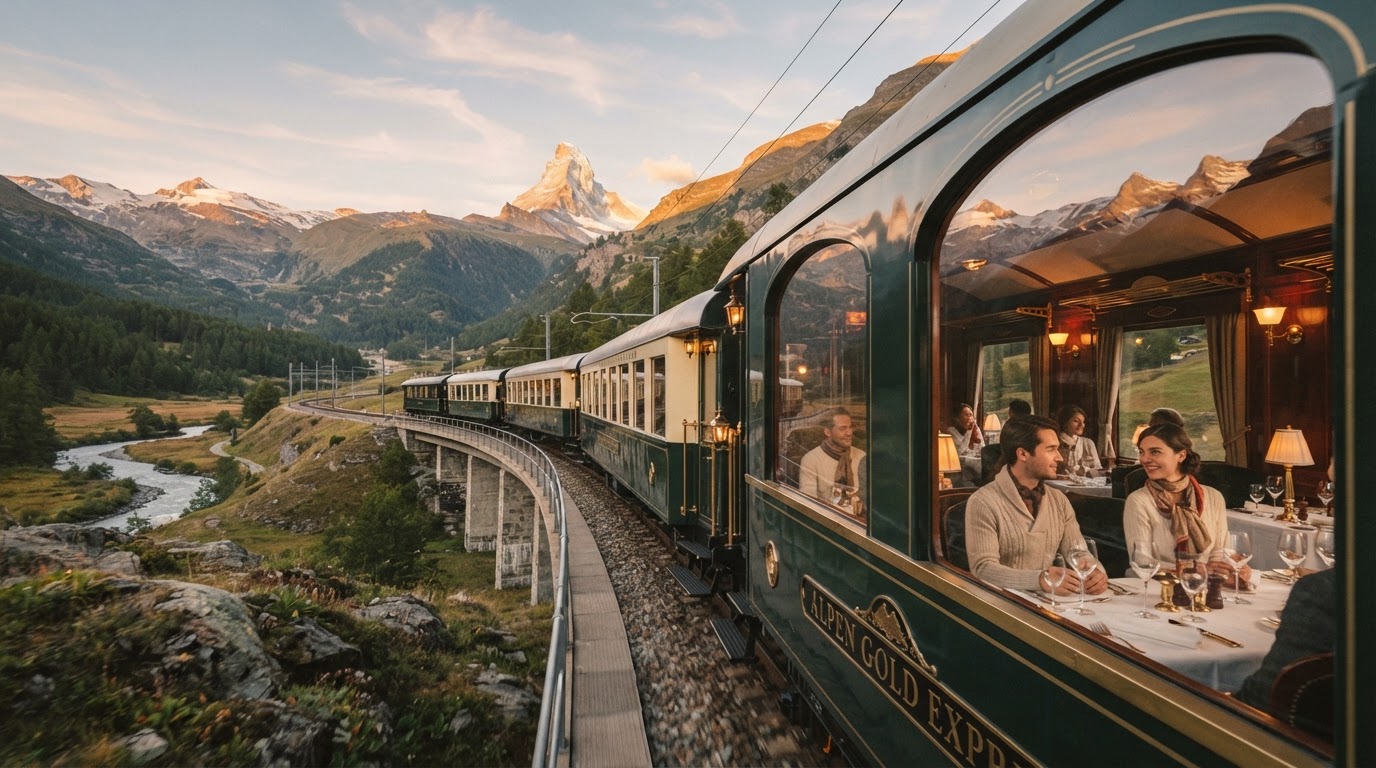
There is a particular kind of quiet you only find on a moving train. The landscape passes the window in a continuous scroll, the dining car is a short corridor away, and the only decision the day requires of you is whether to watch the scenery from your cabin or from the observation car. This is the romance of luxury train travel, and it is not a marketing invention — it is a mechanical fact. The train absorbs the two worst parts of any multi-city itinerary, the driving and the unpacking, and replaces them with the two best parts of slow travel, the scenery and the not-doing-anything. For the traveler who has spent a career getting efficiently from place to place, that trade is quietly revolutionary.
But the romance has a reality attached to it, and the reality is what separates the travelers who fall in love with rail from the travelers who feel trapped by it. A luxury train is not a cruise ship on rails. The route is fixed. The schedule is fixed. The cabin is smaller than the smallest hotel room you have ever booked, and the price per night would buy a very nice suite on solid ground. Knowing that going in — and booking the right train, the right cabin, and the right direction of travel — is the difference between a trip you remember for a decade and a trip you endure for three nights.
The romance, honestly described
The honest version of the romance is this: a luxury train gives you a moving viewpoint through landscape you cannot reach by road, and it does so while handling every logistical annoyance of a multi-city trip. There is no check-in at each town, no repacking, no navigation, no driving. Your cabin travels with you. The dining car travels with you. The bar, the observation lounge, the small library — all of it moves, and you move with it, through scenery that would otherwise require a rental car and a driver's full attention to see at all. The Venice Simplon-Orient-Express passes through the Alps at a pace that lets you watch the light change on a glacier. The Belmond Royal Scotsman threads the Scottish Highlands on tracks that no road follows. The Seven Stars in Kyushu circles volcanic coastline that is, by design, the slowest way to see the island.
This is the part of luxury train travel that converts skeptics. The traveler who expected a gimmick finds, instead, that the train has done something no hotel can: it has made the travel time the most memorable part of the trip. The days that are usually lost to transit — the airport, the transfer, the drive — become the days you remember. For travelers who have spent a lifetime treating the journey as the cost of the destination, that inversion is the entire appeal.
"A luxury train does something no hotel can: it makes the travel time the most memorable part of the trip. The romance isn't the polished brass — it's the fact that the days you usually lose to transit become the days you remember. The traveler who books the right train, the right cabin, and the right direction of travel gets the romance. The traveler who books the brochure default often gets the reality without it."
— Well TRVL'd Editorial Team, after a decade of luxury-rail editorial features
The reality, honestly described
The reality is the part the brochure photographs leave out. A luxury train cabin is small — often smaller than a standard hotel room, sometimes smaller than a cruise inside cabin — because the carriage dimensions are fixed by a rail gauge that predates the concept of luxury. The route is fixed, which means the train decides your pace, not you. If the schedule says you pass the best scenery at six in the morning, you pass it at six in the morning, whether you are awake or not. The dining is a set menu at a set seating, which is part of the charm for most travelers and a constraint for travelers with dietary needs that weren't flagged in advance. And the price — typically $1,500 to $5,000 per person per night — reflects the onboard service and the exclusivity of the cabins, not the distance covered.
None of this is an argument against luxury train travel. It is an argument for booking it with eyes open. The travelers who love rail are the ones who knew going in that the cabin would be small, the schedule fixed, and the dining communal — and who wanted exactly that. The travelers who feel let down are the ones who booked the brochure default, discovered the constraints at dinner on the first night, and spent the rest of the journey comparing the train to the resort they could have had for the same money. The romance and the reality are the same trip. The difference is which one you were prepared for.
Luxury train vs. luxury hotel — what you're actually choosing
| Element | Luxury hotel (stays put) | Luxury train (moves) |
|---|---|---|
| The point of the trip | The destination you've arrived at | The journey between destinations |
| Pace | You decide each day | The schedule decides for you |
| Cabin size | A full hotel room or suite | Smaller — fixed by the rail gauge |
| Dining | À la carte, on your schedule | A set menu at a set seating |
| What you see | One place, in depth | A corridor of scenery you can't reach by road |
| Logistics | You manage transfers and unpacking | The train absorbs all of it |
What to know before you book
Four details decide whether a luxury train trip delivers the romance or just the reality. The first is direction of travel: a south-facing cabin in the morning sees a different trip than a north-facing one, and the best scenery on any route is on one side for one segment and the other side for the next. The second is cabin category: the difference between a historic original carriage and a later addition is the difference between the train you saw in the photograph and a reasonable approximation of it. The third is the dining: set menu, set seating, and dietary needs that must be flagged with the operator in advance, not raised at the table. The fourth is what sits on either end of the journey — a night in the departure city and a night in the arrival city turn a rail trip from an event into a proper itinerary, and they're the part most travelers forget to build in.
This is the same kind of detail we describe in what a travel advisor actually does, and it's especially decisive on a luxury train because the booking platform shows you a cabin category, not a cabin. The advisor knows which historic carriages have the original marquetry and which have the later reproduction, which direction of travel puts the Alps on your side of the train at the hour the light is best, and how to sequence a night on either end so you board rested rather than rushed. For travelers drawn to the unhurried logic of rail, the same instinct that makes slow travel worth it — depth over distance, presence over coverage — is what makes the train, booked correctly, the most romantic form of it.
Book the train, not the brochure
The travelers who come back raving about a luxury train are almost never the ones who spent the most. They're the ones who booked the right train for the right reasons, in the right cabin, in the right direction, with the right nights on either end. The romance of the rails is real — but it is not automatic. It is the reward for booking the train you actually want to be on, prepared for the constraints that make it what it is, rather than the train the brochure default put you on. Get those details right, and the journey becomes the part of the trip you remember longest. Get them wrong, and you'll have spent a small fortune to discover you'd rather have been in a hotel. The difference is preparation — and, more often than not, the advisor who knew which details were the ones that mattered.
Last updated: August 27, 2026. This article is reviewed regularly to keep luxury-rail routes, pricing, and booking strategy current.
Read more from Well TRVL'd: is slow travel worth it · what a travel advisor actually does · find a travel advisor